


Thymosin Beta-4 (TB-500) 20mg Peptide
$99.99 $59.99
✓ Save 40% — Discount Automatically Applied. No Coupon Needed.
Thymosin Beta-4 (TB-4) 20mg Research Peptide
Thymosin Beta-4 (TB-4) 20mg is a lyophilized research peptide commonly investigated in laboratory studies involving cellular migration, connective tissue biology, angiogenesis, tissue remodeling, muscle recovery, skin regeneration, and regenerative signaling pathways.
Research Use Only. Not for human or veterinary use.
Thymosin Beta-4 (TB-4) 20mg Peptide | Research Peptide for Recovery, Tissue Remodeling & Cellular Migration Studies | Peptide Research Hub
Thymosin Beta-4 (TB-4) 20mg
Research Peptide for Recovery, Tissue Remodeling, Cellular Migration & Regenerative Biology Studies
What is Thymosin Beta-4 (TB-4) 20mg?
Thymosin Beta-4 (TB-4) 20mg is a naturally occurring 43-amino-acid research peptide that has become widely investigated for its role in cellular migration, tissue remodeling, angiogenesis, actin regulation, connective tissue biology, and regenerative signaling. As one of the most abundant beta-thymosin peptides found in mammalian tissues, Thymosin Beta-4 has attracted significant interest in laboratory research involving muscle recovery, tendon and ligament physiology, wound healing models, cardiovascular biology, and skin regeneration. 0
Unlike peptides that primarily target hormone receptors, Thymosin Beta-4 is studied because of its interaction with G-actin, where it plays an important role in regulating the cellular cytoskeleton. This relationship makes TB-4 relevant in research involving cell movement, tissue organization, extracellular matrix remodeling, angiogenesis, and regenerative biological processes. 1
Researchers frequently investigate Thymosin Beta-4 in laboratory models involving connective tissue, skeletal muscle, tendon biology, ligament physiology, dermal regeneration, inflammatory signaling, and healthy aging. The 20mg presentation provides an ideal quantity for extended laboratory investigations, comparative peptide research, and long-term regenerative biology studies.
Learn more about the biological role of Thymosin Beta-4 by visiting:
Wikipedia – Thymosin Beta-4
Research Overview
Thymosin Beta-4 has become one of the most extensively studied regenerative research peptides because it participates in numerous biological systems associated with cellular organization and tissue repair. Experimental investigations commonly examine its influence on cell migration, angiogenesis, extracellular matrix remodeling, actin dynamics, connective tissue physiology, muscle recovery, and tissue adaptation. 2
Research involving TB-4 frequently includes laboratory models of skeletal muscle recovery, tendon and ligament biology, dermal tissue remodeling, cardiovascular physiology, epithelial repair, inflammatory signaling, and healthy aging. Because these pathways overlap across multiple biological systems, Thymosin Beta-4 provides researchers with a valuable model for studying coordinated regenerative processes.
The 20mg presentation is particularly useful for laboratories conducting extended investigations, comparative peptide studies, or long-term research protocols focused on regenerative biology and tissue remodeling.
Mechanism of Action & Research Pathways
One of the defining characteristics of Thymosin Beta-4 is its interaction with G-actin, a key component of the cellular cytoskeleton. Through this interaction, researchers investigate how TB-4 may influence cell migration, tissue organization, extracellular matrix remodeling, angiogenesis, and cellular communication. 3
- Actin regulation and cytoskeletal organization
- Cellular migration and tissue remodeling
- Angiogenesis and vascular biology
- Connective tissue physiology
- Muscle recovery and tissue adaptation
- Extracellular matrix remodeling
- Skin biology and dermal regeneration
- Inflammatory signaling research
Because these pathways influence multiple regenerative processes, Thymosin Beta-4 continues to be investigated in experimental models involving recovery, connective tissue biology, wound repair, muscle physiology, and healthy aging research. 4
Thymosin Beta-4 (TB-4) 20mg Research Applications
- Actin regulation and cytoskeletal biology research
- Cellular migration investigations
- Angiogenesis and vascular biology studies
- Connective tissue physiology research
- Tendon and ligament biology models
- Muscle recovery and tissue remodeling research
- Skin regeneration and dermal biology investigations
- Extracellular matrix remodeling studies
- Healthy aging and regenerative biology research
- Comparative peptide signaling investigations
Thymosin Beta-4 vs. TB-500
Thymosin Beta-4 and TB-500 are frequently discussed together because they are closely related in peptide research. Thymosin Beta-4 is the naturally occurring 43-amino-acid peptide investigated in numerous laboratory studies involving actin regulation, cellular migration, angiogenesis, connective tissue physiology, and regenerative biology. TB-500 is a synthetic peptide fragment derived from Thymosin Beta-4 that is commonly used in experimental research focused on similar biological pathways. 0
Researchers often compare both compounds in laboratory models involving tissue remodeling, muscle recovery, tendon biology, skin physiology, extracellular matrix remodeling, and vascular development to better understand similarities and differences in their biological activity. 1
Why Choose Peptide Research Hub?
- Research-focused peptide products
- Clearly labeled compounds with transparent specifications
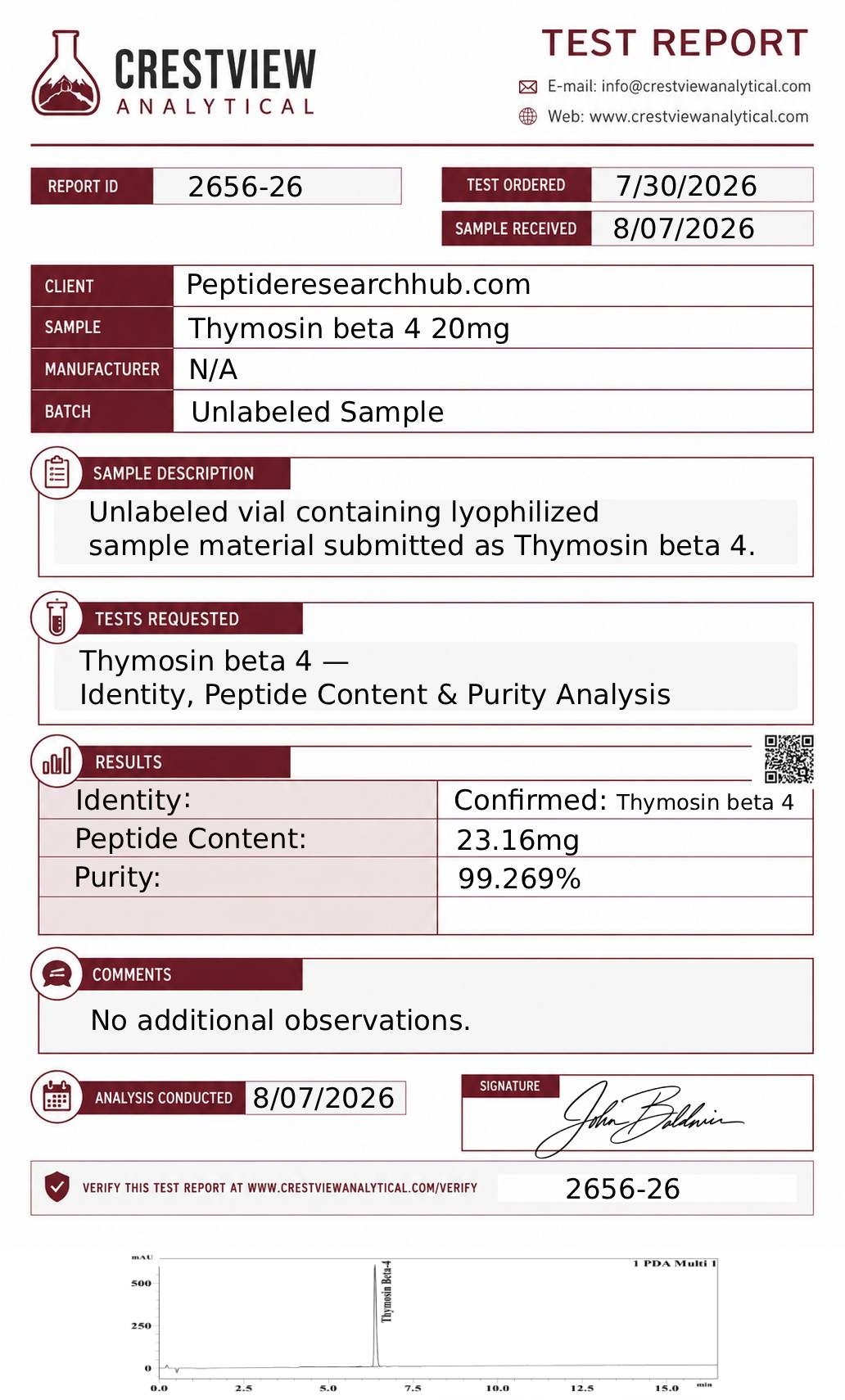
- Third-party testing available for applicable products
- Fast order processing and dependable fulfillment
- Responsive customer support
- Detailed product information designed for laboratory researchers
Researchers can review available analytical reports on our
Third-Party Testing
page.
Product Specifications
- Product: Thymosin Beta-4 (TB-4) 20mg
- Compound: Thymosin Beta-4
- Peptide Length: 43 amino acids
- Quantity: 20mg per vial
- Form: Lyophilized powder
- Appearance: White to off-white powder
- Category: Research peptide
- Research Focus: Cellular migration, connective tissue biology, tissue remodeling, angiogenesis, actin regulation, and regenerative research
- Use: Laboratory research only
Storage & Handling
Store Thymosin Beta-4 20mg according to standard laboratory procedures for lyophilized peptides. Protect the material from excessive heat, moisture, and direct light. Proper storage helps preserve peptide integrity and consistency for controlled laboratory investigations.
Frequently Asked Questions
What is Thymosin Beta-4 20mg?
Thymosin Beta-4 20mg is a 43-amino-acid research peptide investigated for cellular migration, actin regulation, connective tissue biology, angiogenesis, and regenerative signaling.
What is Thymosin Beta-4 commonly studied for?
Researchers investigate Thymosin Beta-4 in laboratory models involving muscle recovery, tendon and ligament biology, connective tissue physiology, tissue remodeling, skin biology, and vascular development. 2
Is Thymosin Beta-4 the same as TB-500?
No. Thymosin Beta-4 is the naturally occurring peptide, while TB-500 is a synthetic fragment derived from it. Both are investigated in regenerative biology but are distinct compounds. 3
Is this supplied as a lyophilized powder?
Yes. Thymosin Beta-4 20mg is supplied as a lyophilized research peptide.
Is Thymosin Beta-4 intended for human use?
No. This product is intended strictly for laboratory research and analytical applications. It is not intended for human or veterinary use.
Related Research Peptides
Research Use Only: Thymosin Beta-4 (TB-4) 20mg is intended strictly for laboratory research and analytical applications. Not for human or veterinary use.
Be the first to review “Thymosin Beta-4 (TB-500) 20mg Peptide”
Related products

Peptides
✓ Save 40% — Discount Automatically Applied. No Coupon Needed.
✓ Save 40% — Discount Automatically Applied. No Coupon Needed.

Peptides
✓ Save 40% — Discount Automatically Applied. No Coupon Needed.

Peptides
✓ Save 40% — Discount Automatically Applied. No Coupon Needed.
Peptides
✓ Save 40% — Discount Automatically Applied. No Coupon Needed.

Peptides
✓ Save 40% — Discount Automatically Applied. No Coupon Needed.

Peptides
✓ Save 40% — Discount Automatically Applied. No Coupon Needed.
Peptides
✓ Save 40% — Discount Automatically Applied. No Coupon Needed.
Reviews
There are no reviews yet.